
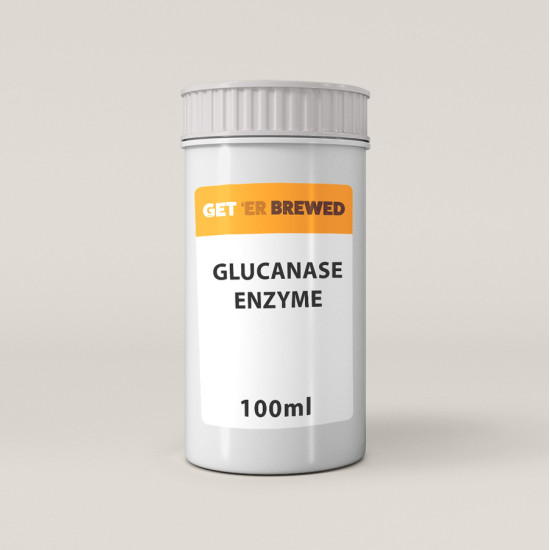
Glucanase
- Stock: In Stock
- Code: GEB4715
Available Options
Glucanase Enzyme
100ml or 1L Option
Improve mash flow, wort clarity, and brewing efficiency with Murphy and Son Glucanase — an advanced brewing enzyme designed to break down naturally occurring gums and complex carbohydrates found in malted grains.
This enzyme helps brewers achieve smoother wort run-off, faster filtration, clearer beer, and improved extract efficiency, especially when brewing with high beta-glucan grain bills or difficult mash compositions.
Despite the technical science behind it, Glucanase is very simple to use and can make a noticeable difference to brewing performance for both homebrewers and commercial breweries.
Quick Overview
- Brewing enzyme for improved mash performance
- Helps reduce stuck or slow sparges
- Improves wort run-off and filtration
- Can improve beer clarity
- Helps reduce wort thickness and viscosity
- Useful with wheat, oats, rye, and high adjunct brewing
- Suitable for homebrew and commercial brewing
Product Profile
Product Type: Brewing Enzyme
Enzyme Activity: Beta-Glucanase, Xylanase & Hemicellulase
Purpose: Improve Mash & Filtration Performance
Suitable For: Brewing & Wort Production
Application Stage: Mash, Fermentation & Conditioning
Main Benefit: Reduced Viscosity & Improved Filtration
What Does Glucanase Actually Do?
Some brewing grains naturally contain compounds called beta-glucans. These can make mash and wort thicker, slower to filter, and more difficult to separate during brewing.
High beta-glucan levels are commonly found when brewing with:
- oats
- rye
- wheat
- under-modified malt
- large grain bills
Glucanase breaks down these compounds, helping create:
- smoother wort flow
- faster sparging
- improved filtration
- clearer finished beer
- better extract efficiency
In simple terms:
- it helps your brewing process flow more easily and efficiently.
Why Brewers Use Glucanase
Brewers often use Glucanase to help prevent:
- slow mash run-off
- stuck sparges
- cloudy beer caused by excess glucans
- poor filtration performance
- thick or gummy mash conditions
It is especially useful in modern beer styles using oats and wheat, such as:
- NEIPAs
- hazy pale ales
- wheat beers
- rye beers
- adjunct-heavy recipes
Key Benefits
- Enhanced mash filtration
- Faster wort separation
- Reduced wort viscosity
- Improved extract yield
- Better beer clarity
- Improved filtration efficiency
- Helps with difficult grain bills
- Easy to use in multiple brewing stages
How To Use
Mash Addition
Add directly to the mash at:
0.5–1kg per metric tonne of grist ( 0.5–1g per kg of grist )
The exact rate depends on:
- mash composition
- grain selection
- beta-glucan levels
For homebrewers, very small amounts are typically required.
Fermentation Use
Can also be added during fermentation at:
7–20ml per hectolitre ( 0.07 - 0.2 ml per litre )
Conditioning Use
For conditioning tanks:
7.5–20ml per hectolitre ( 0.075 - 0.2 ml per litre )
Brewing Guidance
For best results:
- Mix thoroughly into the mash or wort
- Use within shelf life guidelines
- Follow dosage recommendations carefully
- Particularly beneficial in high oat or wheat recipes
Using Glucanase alongside proper mash temperatures and water chemistry can significantly improve brewing consistency.
Perfect For Brewers Who
- Brew hazy or oat-heavy beers
- Experience slow sparges
- Want clearer wort and beer
- Use wheat or rye regularly
- Want improved brewing efficiency
- Brew high adjunct recipes
Frequently Asked Questions
What is a brewing enzyme?
Brewing enzymes help break down specific compounds during brewing to improve efficiency, fermentation, filtration, or clarity.
What are beta-glucans?
Beta-glucans are natural gummy carbohydrates found in grains such as oats, rye, and barley. High levels can create thick mash and filtration problems.
Will this affect flavour?
Glucanase is designed to improve process performance rather than significantly alter flavour.
Is this useful for NEIPA brewing?
Yes. NEIPAs often contain high levels of oats and wheat, which can increase beta-glucan content and create thicker mash conditions.
Can this help prevent stuck sparges?
Yes. One of the main reasons brewers use Glucanase is to improve wort flow and reduce mash filtration issues.
Is this only for commercial breweries?
No. While dosage rates are often given for commercial brewing, homebrewers can also benefit from using brewing enzymes in challenging grain bills.
Why Use Brewing Enzymes?
Modern brewing recipes increasingly use ingredients that can challenge mash and filtration performance.
Brewing enzymes like Glucanase help brewers:
- improve consistency
- reduce brewing problems
- increase efficiency
- improve beer clarity
- work more effectively with modern grain bills
This makes them particularly valuable for advanced homebrewers and experimental brewing setups.
Important Usage Information
- Check shelf life before use
- Read safety information before handling
- Ensure proper mixing and dispersion
- Store according to manufacturer recommendations
Always use brewing enzymes responsibly and according to dosage guidelines.
Delivery from Get Er Brewed
Your order will be dispatched from our warehouse and delivered by your choice of courier service that we provide.
Please click on the link below for more information on the available delivery services.
DELIVERY INFO
Once your order has been packed and is ready for delivery, our team will inform you of the dispatch date and the delivery reference number.
Weight Limits:
The weight limit is 30kg for DPD and 70kg for DHL, either by volumetric or actual, whichever is greater. (Remember, a large packing box weighs 1kg of that total weight).
For products or orders over these weights, the PALLET SHIPPING option is available.
We
try our utmost to package professionally and keep your items as safe as
possible. If your parcel arrives damaged, please ensure you sign for it
as received damaged and send us a brief description of what has happened
and a few pictures so we can provide the courier with feedback to
resolve.
For any more information, please contact us at 0800 2289 433 or send an email to [email protected].