
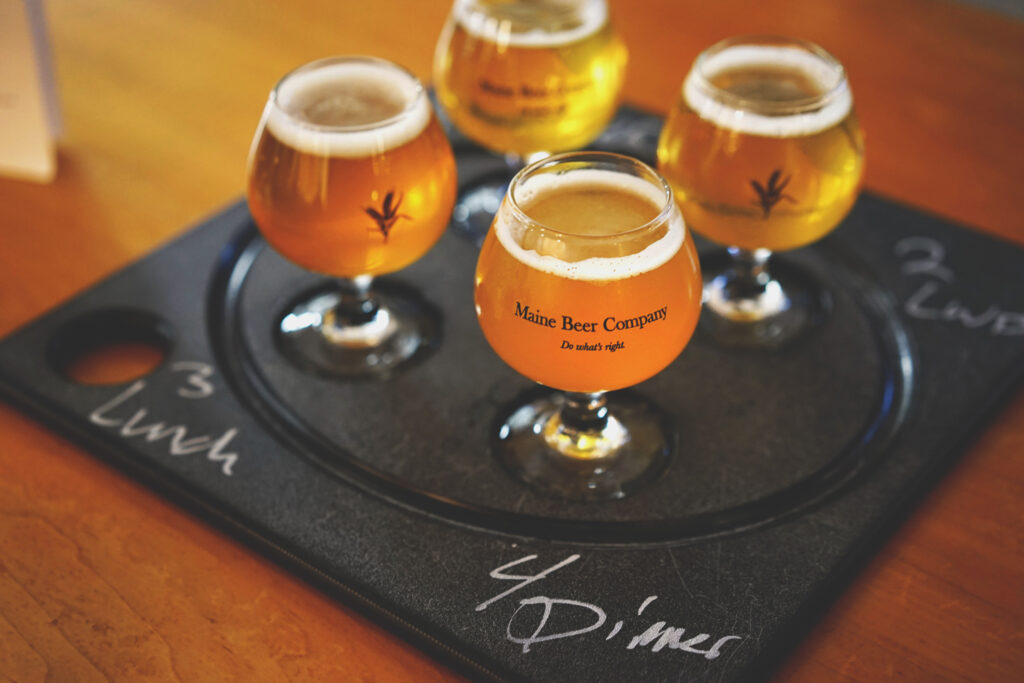
At Sacred Profane in Biddeforde, Maine, owner and head brewer Brienne Allan brews two beers: a pale lager, and a dark lager. A third beer, its amber, is simply a blend of both core beers. The occasional special will also typically be a riff on its two flagships, for example, a smoked version of the dark lager. Service in what it calls its ‘tankpub’ is via imported, Czech style serving tanks suspended above the bar, which also features Lukr side pour taps that are – you’ve guessed it – direct from the Czech Republic.
It’s all part of a valuable USP. There are over 50 breweries in the Portland, Maine greater metropolitan area alone, and standing out is key. Being able to serve gorgeous looking (and tasting) pints of authentic, Czech style lager – that’s triple decoction mashed, by the way – gives this particular brewery an irresistible hook. I certainly found it to be the most compelling and enjoyable taproom I visited on my stay in the area in September 2025.
The brewing scene in Portland doesn’t exist in a microcosm. It’s part of the largest brewing economy in the world, which at one point boasted more than 10,000 breweries across all 50 US states. Now that number has shrunk to around 9600, as the industry goes through a period of correction and consolidation as a result of various market pressures.
Just like in the UK, American breweries are being squeezed until their cloth is dry. The rising cost of raw materials, along with other associated costs and the pressures of inflation, make running a brewery less cost effective. Meanwhile, consumers have less disposable income, so spending isn’t as free and able as it was just a few years ago. It’s not all doom and gloom, as my visit to Sacred Profane, and indeed several other breweries in the Portland area was testament too, but these are not comfortable times for any producer of beer in the United States.
I was in Maine as part of a two week visit to the US that also took in parts of Colorado, during which I decided to try and take stock of how the largest and most influential brewing nation is doing amid financial (and, yes, political) struggles. There was a time when what was happening in the American beer scene was influencing beer and breweries across the entire globe. And yet now, just like in other countries – including the UK and Ireland – it has seemingly hit a wall.
As with the UK, when we ourselves topped 2000 breweries in 2019, there has always been talk of the US market hitting its saturation point. These were comments I was always dismissive of when the industry on both sides of the pond was going through its golden years of growth from the mid-2000’s onwards. America, in some ways, felt too big to fail. Yes there were 10,000 breweries, but these were largely spread out across a vast continent, and where they were most concentrated – for example in California – there was typically a large population to match.
On reflection that optimism now feels somewhat misplaced, 10,000 does seem like possibly more operators than one sector can accommodate, even in a country as large as the United States. As such, it is breweries putting in the hard work on the ground in terms of quality and accessibility that are still largely managing to make ends meet. But it’s not quite as simple as just making good beer and hoping people buy it. Finding an angle that is appealing to potential customers, and then finding an effective way to communicate that is vital, and during my stay I noticed two methods in particular that were proving to be effective.
Nostalgia is one play many breweries seem to be using. During my time in both Portland and in Colorado, (the latter of which I visit regularly to see family,) I noticed that many drinkers seem to be choosing the classics made by more established breweries. Allagash White, the Belgian style witbier from the brewery of the same name wasn’t just on tap everywhere in Portland, but it felt like everyone was drinking it too. The beer carries the kind of hushed reverence that money can’t buy, and demonstrated to me why establishing a core beer as part of your brewery’s identity is essential for longevity.
In the UK we’ve seen a similar sense of nostalgia grab drinkers – especially younger drinkers – by both lapels. The Guinness boom has put stout in the spotlight, with Murphy’s, Beamish and challenger brands from smaller breweries – for example London Black from Anspach & Hobday – trying, and succeeding to eke out their little piece of the market. Seemingly on the back of this the world’s largest beer manufacturer, Anheuser Busch InBev, has started to push two of the most nostalgic brands in its extended portfolio: Bass and Boddingtons. The latter of which was relaunched on cask in the UK while I was away in the US. There’s something comforting in thinking back to what we perceive as ‘better’ times, and you can bet the world’s largest brewing concerns are going to capitalise on this, so why shouldn’t small independents, too?
It felt as though there was a similar sentiment for the classics over in the US. Guinness seemed to have the same level of ubiquity over there as, say, Bud Light (although also fascinating was the sheer volume of people opting for low-calorie lagers like Michelob Ultra.) But what does that leave you with when you’re a small, relatively young brewery that doesn’t have that kind of legacy to lean on?
For my money, the most valuable thing I saw any small brewery taking advantage of was their inherent sense of authenticity. That’s exactly what Sacred Profane is doing, by trying to be as true to the Czech beers that inspired them in the first place. Even their pilsner malt is being imported from the Czech Republic.
At Stodgy Brewery in Fort Collins, Colorado, I also noticed that the provenance of their ingredients was the most important story they had to tell. Its beers are all proudly made with malt produced by local ‘craft’ maltster, Troubadour Malt, which is also based in Fort Collins, and sources all of its barley from farms within 60 miles of the city. In Stodgy’s taproom, the fact that their beers are made with local malt is prominently displayed on the taplist. Even some of their hops are sourced from within Colorado, and this is where being small is almost like having a superpower. There just aren’t that many hops grown in this state, so to use these as opposed to those freighted in from Washington or Oregon feels like a real pull.
The provenance of ingredients feels like something we can take for granted in the UK, but with suppliers on our doorstep like Simpsons, Muntons, and French and Jupps, leaning into and celebrating this locality feels like a no brainer. Customers in the US certainly seem interested in where the ingredients for their beer come from, so why shouldn’t they do the same in the UK and Ireland?
That’s not to say that Stodgy isn’t leaning into nostalgia as well. They’re also capitalising on the popularity of European beer traditions, with their occasional ‘Kölsch service’ being offered at select times over the summer in their tree-covered beer garden. I saw the same thing advertised at another brewery, Fritz Family Brewers, in the nearby city of Niwot, with many regulars on my visit telling me how it was the highlight of the week. In terms of events and occasions like this, it still feels like there’s a lot of potential that isn’t being tapped into by UK breweries, when in the US it almost feels commonplace.
Despite its struggles, the main reason I always find immersing myself in the US beer scene so reinvigorating is that there’s a certain ‘never say die’ attitude to their entrepreneurship I can’t help but admire. Sure, the chips are down, and some breweries won’t succeed (RIP to Denver’s TRVE Brewery, one of my personal favourites and a huge loss.) But it’s this ability to innovate and find ways to ensure people keep coming back for more.
One thing’s for sure, whatever hook you choose to hand your marketing hat upon, it is the beer itself that’s the most key part to any brewery’s continued success. Something that still astounds me when I visit the US is just how high the beer quality is above the board. It might sound obvious, but if you’re wanting to lean into nostalgia or authenticity in terms of your marketing, then you better be sure the beer you’re making is no less than excellent. After 15 years of visiting the US, for me this is still far and away the biggest lesson we can learn from our friends on the other side of the Atlantic.
— Matthew Curtis

Get ‘Er Brewed is proud to support Pellicle Magazine, which is owned and run by Matt. If you enjoy these blog posts, make sure you head over to pelliclemag.com and read their latest features, and listen to some of their fantastic podcast episodes.